- calendar_today August 27, 2025
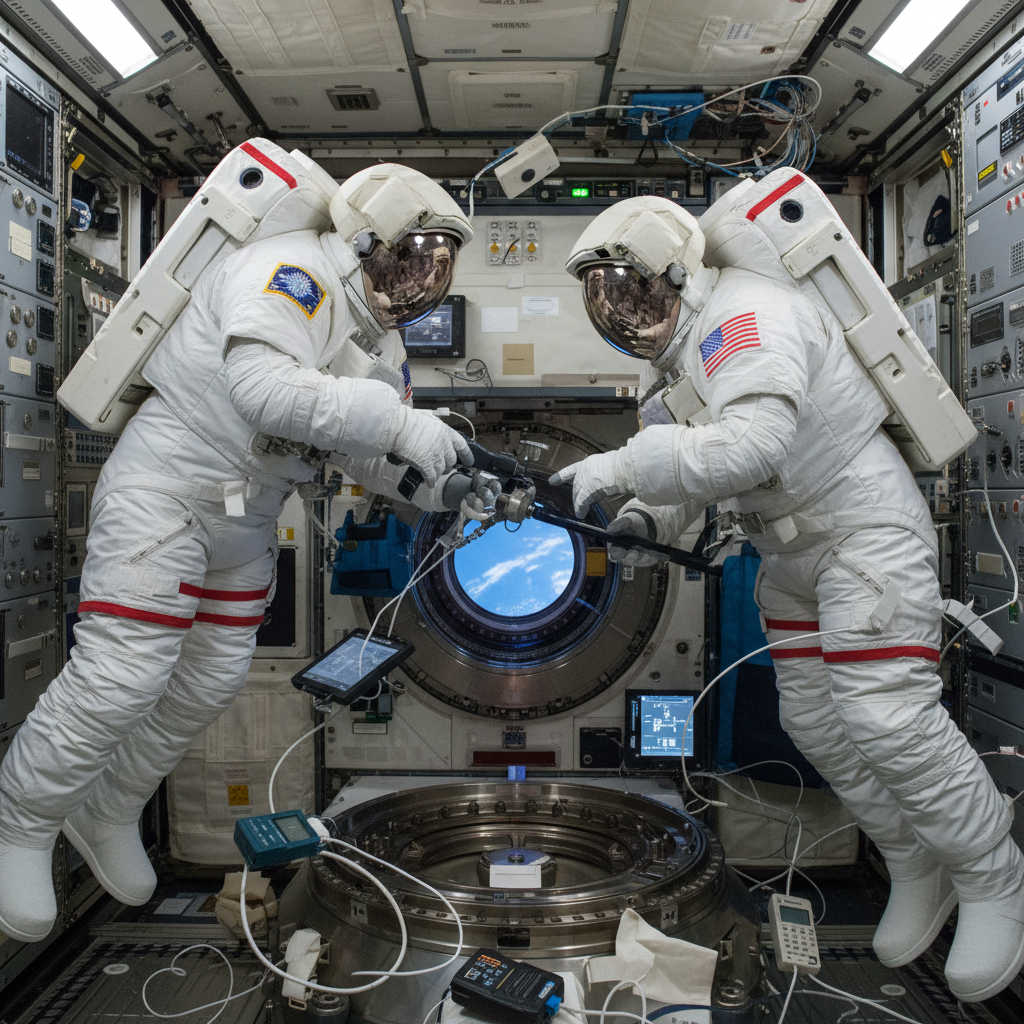
NASA postponed the launch of a commercial astronaut mission due to a serious air leak on the International Space Station (ISS). The agency has officially recognized the problem by postponing Axiom Mission 4 which was scheduled to transport four private astronauts to the orbital station but remains silent about the specifics. Confidential sources reveal that the management of the ISS air leak situation has grown more urgent as the station reaches 30 years of continuous operation.
The Return of a Familiar Problem
Leaks have been an ongoing issue for the ISS throughout its operational history. NASA and Roscosmos have monitored a continual slow leak since 2019 within the Zvezda service module which was built by Russia and launched in 2000 as one of the International Space Station’s oldest components. The troublesome leak area is in the PrK transfer tunnel which connects Zvezda to a docking port for Soyuz crew vehicles and Progress resupply missions.
Russian cosmonauts have conducted numerous repair attempts on the small cracks found in the PrK throughout the last several years. Their repair attempts limited the leak to about two pounds of air per day but failed to eliminate it completely. The best short-term solution proved to be closing the PrK hatch whenever docking operations were not underway.
Roscosmos announced last month that their latest repair effort has fully fixed the leaks in the PrK module. NASA released a statement confirming that the leak rate within the module had ceased. The initial response to this news was to view it as a victory for the maintenance work in progress. The feeling of success diminished when sensor readings demonstrated that the entire station’s air pressure remained on a downward trend.
According to people who know about the situation the primary problem is now believed to be with the hatch seals. Experts think air from the main station area is passing through the hatch to the PrK while the PrK maintains its internal pressure. The PrK’s tight seal maintains local pressure while concealing the ISS’s continuous overall air loss. The leak seems to be fixed within the module yet it persists in impacting the entire station.
Structural Fatigue: A Growing Threat
The ongoing leak is not yet hazardous but it reveals a more concerning underlying problem of structural fatigue. The engineering community is concerned about high cycle fatigue which occurs when aluminum metals endure repeated stress cycles during operation. Repeated bending and stressing of a wire eventually leads to breakage and this is comparable to what happens with metals in structural fatigue.
Since the late 1990s the ISS has faced daily thermal swings and mechanical stress along with pressurization cycles while remaining in orbit. Aerospace-grade aluminum eventually becomes brittle and unpredictable despite its initial strength. Structural cracking holds the top position as NASA’s most major risk according to its internal 5×5 risk matrix which evaluates both the likelihood and impact of issues. The agency tracks no issues at a higher concern level than this one.
This is not just a theoretical fear. During 1988 a mid-flight decompression occurred on Aloha Airlines Flight 243 because of metal fatigue that went undetected. The plane suffered a sudden structural failure when part of its fuselage detached unexpectedly and passengers were left exposed to the open sky. The crew successfully landed the aircraft but the incident stands as a stark warning of the dangers that undetected fatigue can cause.
The International Space Station has aged to the point where certain components are approaching their operational limits. Multiple leaks occurring around the same module generate concerns about potential widespread fatigue becoming a critical safety problem.
NASA postponed the scheduled Thursday launch of the Axiom-4 mission because of these circumstances. The agency announced that the postponement will give NASA and Roscosmos extra time to assess the current situation and decide if further troubleshooting steps are required.
NASA continues to withhold a thorough explanation in response to increasing inquiries from both journalists and the general public. The agency’s only public comment to date has been: The team of astronauts on the International Space Station continues to perform standard operations safely.
For now, that remains true. The crew members aboard the space station remain secure while their daily work proceeds as usual. The increasing frequency of mysterious leaks on the ISS together with concerns that these indicate serious structural problems has created an urgent need to determine how much longer the station can operate safely.