- calendar_today August 15, 2025
Giger vs. Hollywood: Species and the Struggle for Creative Control
Michael Madsen, who recently passed away earlier this month after a career that saw him take on numerous cult-classic and fan-favorite roles across decades of Hollywood filmmaking, is best remembered for his work in films like Reservoir Dogs, Kill Bill, and Donnie Brasco. However, with just a quick look at his filmography, one of his more atypical roles can be found as well: the mercenary who joins the CIA to hunt a half-human/half-alien hybrid in the ’90s sci-fi/action/thriller/horror hybrid Species. This year, the film is turning 30 years old, and with a cast that includes Madsen, Ben Kingsley, Marg Helgenberger, Alfred Molina, and Forest Whitaker, it’s one that still makes for a guilty pleasure.
Species, directed by Roger Donaldson (No Way Out, The Bounty), worked through multiple genres with its stranger-than-fiction premise. The U.S. government receives two transmissions from space: one contains the formula for a next-generation fuel source, and the other detailed instructions on how to splice alien DNA with human DNA. The government, naturally, follows through on both. Guided by Dr. Xavier Fitch (Kingsley), a fully grown hybrid is produced: Sil, in her prepubescent years, played by Michelle Williams. The whole point of the experiment was to produce a domesticated and controllable animal. Instead, something completely different happened.
Sil evolves at a much faster rate than a normal human child, only taking three months to develop to the appearance of a 12-year-old. However, she’s got violent dreams, and other clues that point to her being a bit more “wild” than the scientists expected. Fitch decides to shut down the experiment by flushing cyanide into Sil’s containment chamber, but the plan backfires—Sil escapes, and the chase is on.
To find and recover her, Fitch recruits a team of experts, including Preston Lennox (Michael Madsen), a black ops mercenary who can be relied upon to “take care of it”; Dr. Laura Baker (Helgenberger), a molecular biologist; Dr. Stephen Arden (Molina), an anthropologist; and Dan Smithson (Whitaker), an empath who can track Sil by reading her emotions. Fitch and his team set out on a cross-country hunt, with Sil eventually ending up in Los Angeles, where she had grown up and gained superhuman strength. Played by Natasha Henstridge, Sil sets about hunting and mating to fulfill her biological purpose. Henstridge was cast to play Sil only after Ridley Scott saw her work in Timecop and was instantly impressed. Her look was her own, with her specific features chosen by Scott after he was shown 20 possible character designs by the special effects team. Henstridge put on 30 pounds for the role and also did much of her stunt work.
Sil can be clever, she can be adaptive, but ultimately she’s also primal in her drive to mate and reproduce. She kills in strange and creative ways (training with a fight team so she can take out a nightclub victim), and takes her time seducing her chosen mate (Oscar-winner Ben Kingsley). In the meantime, the body count piles up: a train tramp, an oblivious boyfriend, a nightclub victim. To stop her, Fitch and his team need to stop her before the eggs mature and produce a new crop of Sils, who will also be super-intelligent and potentially grow just as quickly.
Crafting a Creature of Seduction, Strength, and Style
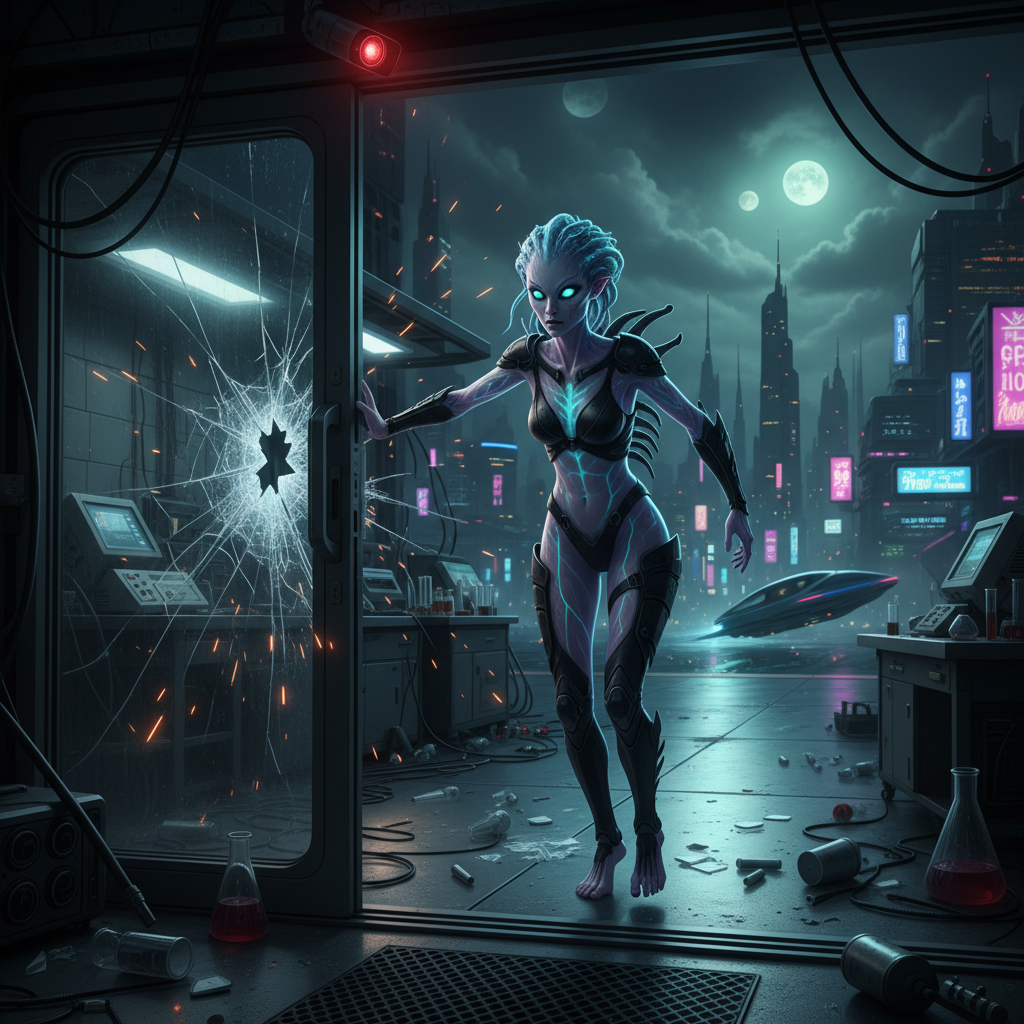
Creating the creature that was Sil was an exercise in imagination and innovation, not to mention special effects artistry. Legendary surrealist artist H.R. Giger, known primarily for his work on the alien from Ridley Scott’s 1979 classic Alien, was brought on to produce Sil’s look and aesthetic. Giger wanted to make Sil an “aesthetic warrior, also sensual and deadly.” Giger described Sil’s final adult form as having translucent skin, “looking like a glass body but with carbon inside.” Giger developed four distinct stages of alien/human evolution for Sil. But with a limited production budget and time, those plans had to be toned down—instead, they went with just a transformation cocoon and then the climactic maternal alien body (Sil goes into labor, producing a variety of pre-built Sil eggs).
The film was a hit with audiences, but Giger was frustrated with the final result. He thought that Species leaned too hard into Alien‘s legacy, with some of the final imagery of the film, including the “punching tongue” at the end of the film and the overall “birth” sequence, a little too close to the infamous chestburster sequence from Alien, for his liking. Giger has even claimed that he helped influence the final kill shot for Sil by cutting off production to protest the finale’s similarities to Alien 3 and Terminator 2—specifically, his issues with Sil being killed by flame-throwers instead of the bullet to the head that was ultimately used in the film’s final cut.
Species as a whole suffered from similar issues—flat dialogue, forgettable supporting characters. Kingsley’s Fitch is an amoral, duplicitous character who never quite rings true; Whitaker’s empath exists mostly as a noir-ish third-act shadow character who only states the obvious. There were hints of deeper ideas—bioethics, alien contact, the differences between maternal instincts, and the creation of life—but they were left as only surface-level. Still, there’s a fascination in the film’s strange mix of science fiction with a sexploitation horror core. Feldman was working with an idea: Arthur C. Clarke had published an article in 1973 that suggested that aliens would never make first contact with Earth, based on the idea that for travel to be possible, it would require some sort of faster-than-light technology. So Feldman flipped the argument on its head—what if extraterrestrials were able to contact Earth with plans to build something organic instead? What if that blueprint used blueprints to splice alien DNA with human DNA to create a silent, sentient invader species made out of Earth’s biological materials?
Species then became both a cautionary tale and a creature feature. It’s a project that will probably never find the lofty places of Alien or The Terminator, but it’s unique and appealing in its own right. Species had just enough going on to develop a cult following, and with good reason. Between Henstridge’s haunting performance, Madsen’s weathered badassery, and Giger’s still-startling design, Species is a relic from a bygone era of 1990s science fiction filmmaking that still has plenty to recommend it.
Thirty years on from its initial release, Species is a time capsule of how the genre looked when slick style trumped hard-nosed substance and of how offbeat, one-note character work can end up being some of the most unforgettable work by long-in-the-tooth actors like Michael Madsen.