- calendar_today August 7, 2025
Hobby Game Market Could Collapse Under Tariff Pressure
The board game industry is, by many metrics, a success story. It’s a creative, close-knit community. And when games take off, they can be hard work to produce and offer comparatively slim profit margins. But this week, the industry was dealt a potentially existential financial body blow.
Board game designer Jamey Stegmaier, creator of hits like Scythe and Wingspan, was unusually distraught in a blog post this week. The reason? An announced 54 percent tariff on goods produced in China and imported into the United States.
“I tried to work on a new game last night,” Stegmaier wrote. “I brainstormed a little, but it’s really hard to make something for the future when that future looks so grim. I mostly just found myself staring blankly at the enormity of the newly announced 54 percent tariff.”
For the designer of some of the world’s bestselling games, it was an uncharacteristically personal post. But the feeling’s not confined to Stegmaier. It’s shaking the entire industry.
A Globalized Supply Chain, Interrupted
American publishers have come to rely on China for their manufacturing. And while other countries—like Germany (the spiritual home of modern tabletop gaming)—also house board game factories, China remains the go-to destination for all-in-one production. That means not just printed cards and boards: Chinese factories also produce custom plastic miniatures, wooden tokens, die-cut boards, and specialty dice that have become common in the industry.
Producing all those elements domestically is theoretically possible, but impractical. “I had someone in the US tell me that it would cost me $10 just for an empty game box to be made,” Stegmaier recalled. For comparison’s sake: that same $10 could produce and package an entire game in China.
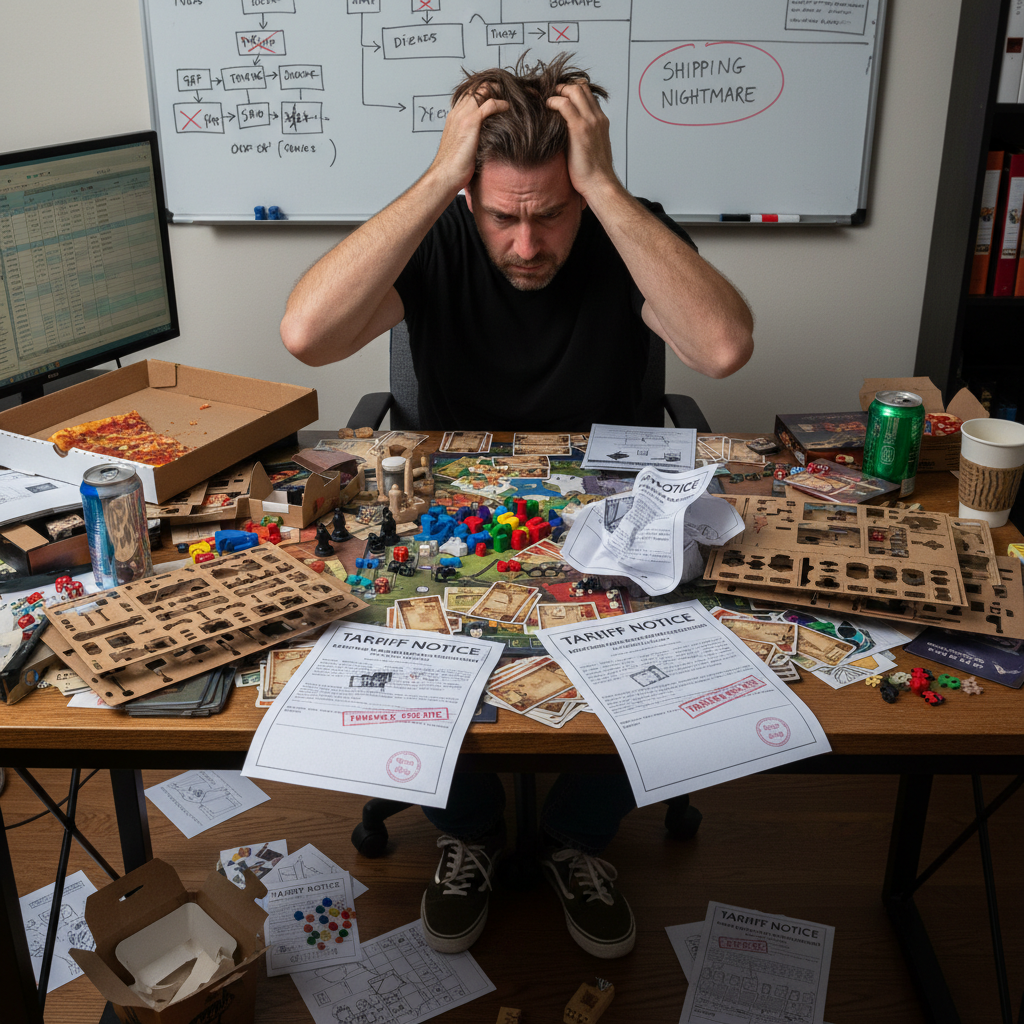
Which is why the new tariff is so profoundly disruptive. By and large, U.S. board game publishers (particularly small and mid-sized ones) operate on narrow margins. In other words, an across-the-board tariff hike like this one is an industry-shattering moment of expense with no cushion of time for adjustment.
Big Names Agree: It’s a Crisis
It’s a sentiment that Stegmaier is not alone in sharing. Meredith Placko, CEO of Steve Jackson Games, weighed in on the subject shortly after Stegmaier’s initial post.
Steve Jackson Games is best known for cult favorites like Munchkin. But their reasons for overseas manufacturing are much the same as for most others in the industry.
“I get it. Some people ask, ‘Why not manufacture in the US?’ I wish we could,” Placko wrote in a post this week. “But the infrastructure to support full-scale boardgame production—specialty dice making, die-cutting, custom plastic and wood components, etc., that happens in China, does not meaningfully exist here yet. I’ve gotten quotes. I’ve talked to factories. Even when the willingness is there, the equipment, labor, and timelines simply aren’t.”
For Placko, the new tariff isn’t just an issue of logistics. It’s a structural threat to the industry itself. “This is not just a policy change,” she wrote. “It’s a seismic shift.”
Rob Daviau, co-founder of Restoration Games and designer of the breakout hit Pandemic Legacy, has been warning of industry collapse on social media for some time. In recent months, he has described almost every business meeting he has had as “an existential crisis about our industry.” In an interview with BoardGameWire, Daviau said that he has been expecting a “great collapse in the hobby gaming market in the US” if tariffs like these were ever to be implemented.
Gamers Could Pay, Too
In the short term, at least, this is going to be painful for more than just publishers and designers. Gamers will likely start to feel the effect as well. New games will almost certainly go up in price at retail. The worst case is that some companies will try to cut corners to keep price points steady, producing cheaper games as a result. The best case is that other companies simply won’t release as many new games as they otherwise would have.
Local game stores, which have long struggled to compete with online-only businesses, also face a potential additional hit. Gamers who, in a pinch, either play from their existing collection (often citing unplayed games in large piles they call “shelves of shame”) or purchase online to get the best prices are further squeezed out of local economies.
“Within a few months, US companies will lose a lot of money and/or go out of business,” Stegmaier said in his original post. “And US citizens will suffer from extreme inflation.”
Slim Workarounds, No Easy Fixes
A few publishers may find ways to get their shipments to non-U.S. distributors. (European markets, for example, aren’t facing similar hikes, though currency rates could affect that calculation.) But those are workarounds, and don’t work for U.S.-based companies. As Stegmaier pointed out, even if their overseas distributors bear the brunt of the financial hit, his company, Gloomhaven’s customers are largely in the U.S. The loss will be acute.
For good measure, it’s particularly galling because of the timing. While some companies may be able to shunt games still in production or the design stage and move to rework their production budgets, it’s too late for games that are already produced, packed, and in transit from Chinese factories. Chris Solis, head of the California-based Solis Game Studio, posted an update on the subject this week. “I have 8,000 games leaving a factory in China this week and now need to scramble to cover the import bill.”
Industry Groups, Lobbying, But Likely Unmoved
The Game Manufacturers Association (GAMA) is a trade and lobbying group that represents the interests of board game publishers. It has, according to the Associated Press, lobbied hard to stop the tariffs. But so far, to no avail.
A move, this story isn’t. With a tariff period beginning 15 December 2019, the industry has little time to make dramatic changes.
For an industry built on joyful, creative collaboration, it’s a move that could hit it at its most vulnerable.