- calendar_today August 14, 2025
.
It’s been a reversal of fortunes for electric vehicles in the United States in recent months. Sales have cooled after more than a year of consecutive month-to-month growth, and the political environment has added more headwinds. Following declines in US EV sales and an administration that has reduced subsidies and repealed vehicle pollution rules, less financial support at the federal level is available for prospective buyers.
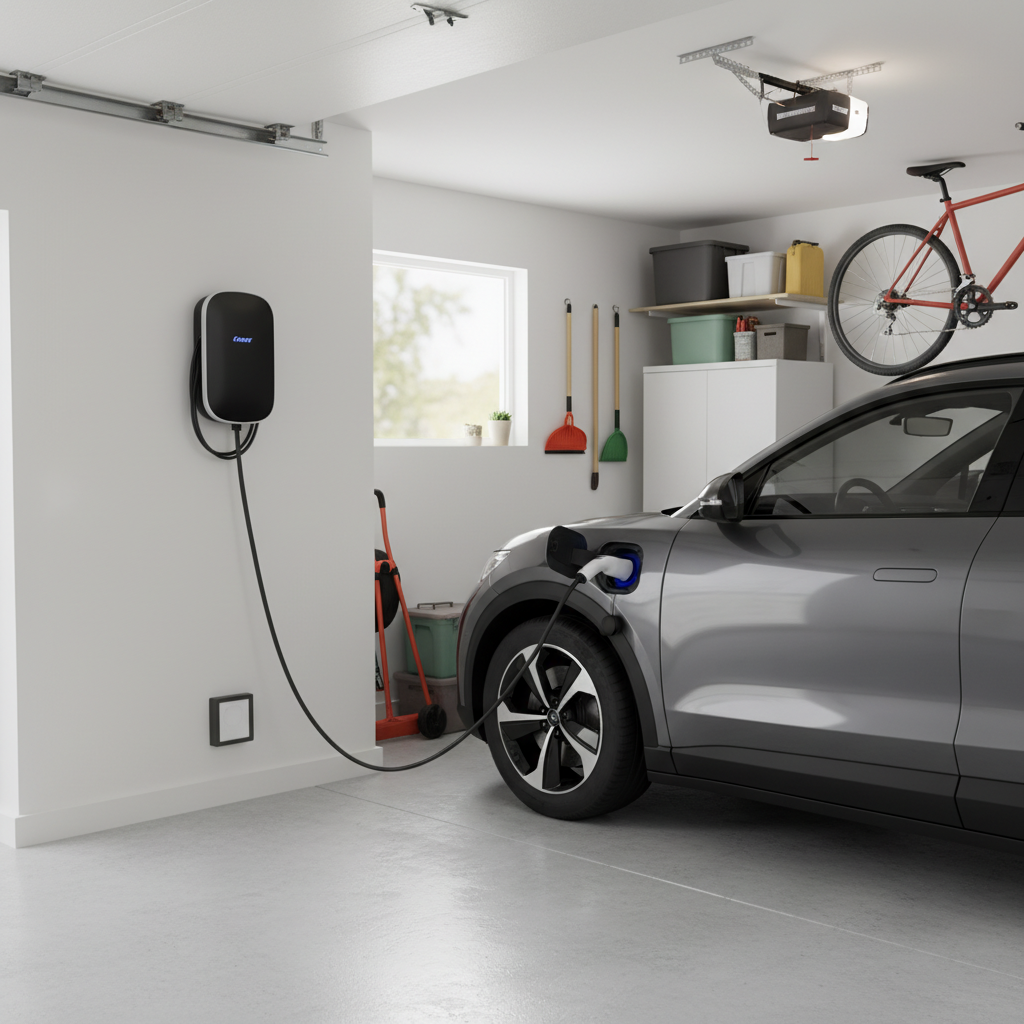
“The issue is availability, or more accurately, lack of availability, of a convenient, adequately powered charging outlet for at least one vehicle,” says Telemetry Vice President Sam Abuelsamid. In a new report, Abuelsamid identifies how one issue many home-owners may take for granted—use of their garage space for storage rather than parking—is becoming a factor for EV owners.
When it comes to charging, most transactions occur at home, and not from the fast chargers that receive most of the attention from policymakers and journalists. AC charging, which provides about 80 percent of all EV charging today, most often takes place at a single-family residence. According to the National Renewable Energy Laboratory (NREL), 42 percent of all homeowners already have their car parked by an outlet that can handle level 2 charging (240 volts).
That share could increase significantly, to 68 percent, if more drivers opened up space in their garage and parked there, as opposed to outside or in a storage space. “Parking behavior, namely whether homeowners use a private garage for parking or storage, will likely become a key factor in EV adoption,” Abuelsamid writes.
Should home-owners begin to use their garages for cars instead of storage, the number of residences with charging capacity would increase from 31 million to over 50 million. All told, the number of homes where charging could potentially be supported—factoring in additional single-family homes where new wiring could be added—is over 72 million. The upper end of that figure already eclipses Telemetry’s most bullish EV adoption projection for 2035: 33 million to 57 million vehicles.
Availability is one thing; affordability is another. Even if a 240-volt outlet is present, that does not mean a home is ready to charge an EV. The NREL study found that nearly 34 million homes would need an electrical upgrade that typically costs thousands of dollars to accommodate a level 2 charger. As Abuelsamid notes, “Level 2 chargers require at least 30 amps, so many homes need some level of electrical work, whether a new circuit from the main service panel to a garage or a sub-panel in the garage, if not a full service panel upgrade.”
If it takes thousands of dollars of electrical work to make a home ready to charge an EV, it could negate one of the key value propositions for the technology: long-term affordability relative to traditional internal combustion engine cars. After all, if the chargers cost as much as the cars do, the total cost of ownership becomes less of a differentiator.
For those who rent or live in multifamily residences (about 23 percent of the US population), the issue is compounded. Individual EV owners in condos, apartments, and townhomes typically do not have the authority to install their own chargers and must instead wait for landlord, property management, or co-op board approval. Even if they are amenable, the financial barrier is larger, as building owners often must make costly upgrades before chargers can be installed.
For example, adding a pair of shared chargers to a co-op may require an entire panel upgrade that costs in the millions. Wiring to individual spots in garages that are far away from any existing panel will only increase the cost. Unlike home-owners, multifamily dwellers often do not qualify for municipal or utility subsidies to defray some of the expense.
As it stands, there are about 1 million EV owners living in multifamily housing. But only 11 percent are parked close enough to an outlet to charge their car. State mandates requiring 20–25 percent of parking spaces in multifamily housing to be EV-ready in new constructions will help increase the number of charging-capable spaces, Telemetry estimates, but still leaves a range of 6.7 million to 11.4 million by 2035 in multifamily buildings, short of projected demand.
In-home charging can get electric vehicles only so far, leaving public charging infrastructure as an essential part of any EV strategy in the US. Telemetry projects that 11.7 million to 14.3 million EV drivers who own homes will use public charging at least some of the time by 2035, even if their residence is capable of supporting charging. A total of 7.8 million to 8.1 million EV owners who live in multifamily residences will also need public charging.
Filling that need will take 523,000 to 586,000 DC fast chargers, as well as another 1.5 million to 1.6 million level 2 chargers across the US. But that in turn will depend on how the electric grid adapts. Utilities are already under pressure from new AI data centers, which will increasingly compete with charging for generation and distribution capacity and are beginning to affect the deployment of large-scale charging sites.
EVs appear poised for continued growth in 2023, at least in the short term. But multiple barriers in the US, particularly for those who live in homes without convenient, powerful garage outlets, threaten to complicate this picture. Price, grid constraints, and challenges in multifamily housing all point to adoption rates that are far from automatic.
For now, a new concern has emerged for policymakers and the industry: What to do with all those cluttered garages?