- calendar_today August 13, 2025
The Southern United States has emerged as one of the most dynamic commercial real estate (CRE) regions in the country. In 2025, the region—from Texas to the Carolinas and across the Gulf Coast—is reaping the rewards of years of inbound migration, business-friendly policies, and aggressive investment in infrastructure and industrial development.
While gateway cities continue to face office market headwinds, the South’s CRE engine is firing on multiple cylinders: warehouse development is booming, manufacturing megaprojects are transforming rural landscapes, and the demand for affordable multifamily and mixed-use development is at an all-time high.
Here’s a detailed look at the commercial real estate recovery and transformation taking place across the Southern U.S. in 2025.
1. Logistics and Industrial Demand Fuel Expansion
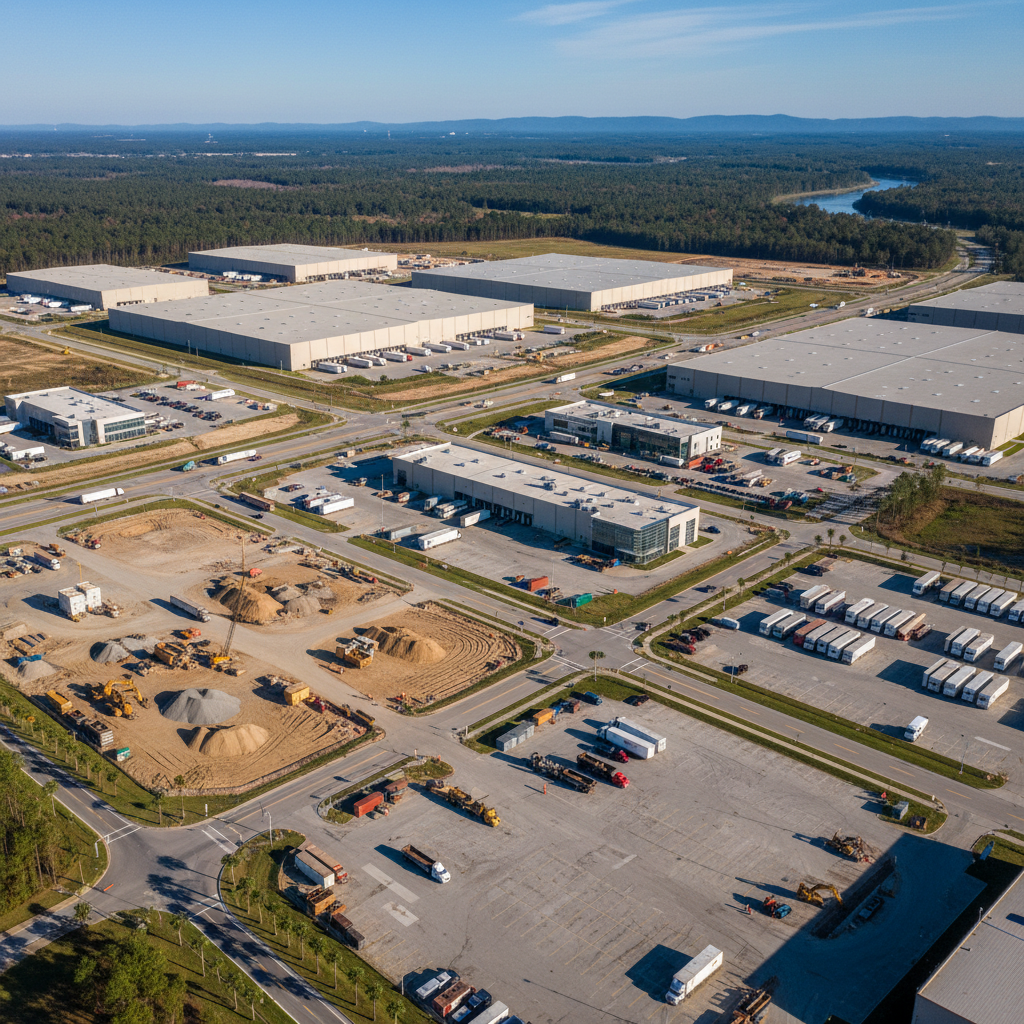
Industrial real estate remains the cornerstone of the South’s CRE strength. Key corridors—such as I-85 in Georgia and the Carolinas, I-10 across Texas and Louisiana, and I-65 through Alabama and Tennessee—have become magnets for logistics centers, last-mile warehouses, and cold storage development.
Port cities like Savannah, Charleston, Mobile, and Houston are seeing massive growth in container traffic, prompting corresponding investment in nearby industrial parks. According to Cushman & Wakefield, Savannah’s industrial vacancy rate remains below 4% as 2025 begins, with over 10 million square feet under construction.
Meanwhile, Tennessee and Mississippi have attracted logistics tenants seeking lower land and labor costs than coastal markets. Major e-commerce, retail, and automotive players are expanding in inland locations, bolstered by robust interstate access and pro-development zoning.
2. Manufacturing Resurgence Redefines Rural CRE
Southern states are capitalizing on a national push to bring manufacturing back to U.S. soil. In 2025, billions in investment have flowed into new electric vehicle (EV), battery, and semiconductor facilities in states like Georgia, North Carolina, Texas, and Kentucky.
Hyundai’s $5.5 billion EV plant in Georgia, Ford’s BlueOval City in Tennessee, and Samsung’s Texas semiconductor hub are among the transformative megaprojects spurring CRE development across entire counties. These projects are driving demand for not just industrial space, but also workforce housing, hotels, retail, and supporting infrastructure in adjacent areas.
In rural and suburban zones, land sales have skyrocketed, and developers are racing to build spec industrial and flex spaces to support suppliers and logistics partners.
3. Sun Belt Cities Lead Multifamily Growth
Multifamily development remains strong in Southern metros, driven by affordability, job creation, and continued migration from higher-cost regions. Austin, Charlotte, Nashville, Raleigh, and Tampa are seeing sustained apartment construction—even as interest rates and material costs remain high.
In 2025, many Southern cities lead the nation in new multifamily starts. According to Yardi Matrix, Charlotte and Dallas are on pace to deliver over 15,000 new units this year, with many focused on Class B and workforce housing. Sun Belt suburbs like Murfreesboro, TN and Gainesville, FL are seeing a surge in build-to-rent (BTR) communities catering to younger households priced out of homeownership.
New state-level zoning reforms, such as Florida’s Live Local Act, are reducing regulatory friction and encouraging transit-oriented and mixed-use housing in urban cores and fast-growing exurbs.
4. Office Markets Shift to Hybrid and Suburban Models
While the Southern office market hasn’t been immune to post-pandemic workplace shifts, its exposure is lower than in Northern and coastal states. In 2025, office vacancies in cities like Raleigh, Jacksonville, and Birmingham hover between 12–15%—well below national averages.
The South’s relative resilience comes from two factors: lower cost Class A product and the prevalence of suburban-style office campuses, which are more compatible with hybrid work. Markets like Franklin, TN (outside Nashville) and Plano, TX (outside Dallas) continue to attract corporate relocations and regional headquarters.
Conversions of outdated office buildings to residential, hospitality, or life sciences uses are underway in parts of downtown Atlanta, Houston, and Charlotte, though these projects face cost hurdles and regulatory timelines.
5. Retail is Localized, Walkable, and Mixed-Use Driven
Retail in the South is evolving rather than collapsing. While malls and traditional big-box retail remain under pressure in some metros, neighborhood retail centers and mixed-use developments are thriving—particularly in walkable suburban nodes and affluent corridors.
Developments like Avalon in Alpharetta (Georgia), Mueller in Austin (Texas), and North Hills in Raleigh (North Carolina) have become blueprints for suburban placemaking, integrating retail, dining, fitness, healthcare, and housing into vibrant districts.
Grocery-anchored centers and medical retail continue to draw investment interest. In Florida and Texas, population growth has created strong fundamentals for convenience retail in both suburban and secondary markets. Retail vacancy rates remain below 6% in much of the region.
6. Hospitality and Tourism Rebound Accelerates
The South’s warm climate, affordability, and rich cultural offerings have fueled a strong tourism rebound. In 2025, hotel occupancy and average daily rates (ADR) have returned to or exceeded pre-pandemic levels in most Southern metros.
Cities like New Orleans, Orlando, Nashville, and Savannah are expanding their hotel footprints to meet growing leisure and convention demand. In Florida, demand for short-term vacation rentals remains strong despite tightening local regulations.
Secondary markets like Asheville (NC), Gulf Shores (AL), and Waco (TX) are seeing a surge in boutique hotel development and hospitality-themed mixed-use projects.
7. Investment Capital Flows Remain Strong—But Selective
The South continues to draw institutional and international investment due to its strong demographic trends, business-friendly climate, and lower price points relative to coastal markets. However, in 2025, capital is more selective—focused on stabilized assets and growth corridors.
According to MSCI Real Assets, Dallas-Fort Worth, Atlanta, and Miami ranked among the top five U.S. metros for CRE transaction volume in early 2025. Private equity firms are increasingly active in secondary markets such as Huntsville (AL), Greenville (SC), and Ocala (FL), pursuing value-add and land banking opportunities.
Cap rates in the South remain compressed for prime industrial and multifamily assets, but have widened for office and older retail. Deal structures increasingly include seller financing, preferred equity layers, and public incentives—especially for projects tied to job creation.
The Southern CRE Advantage: Growth Backed by Fundamentals
What sets the Southern U.S. apart in 2025 is not just the volume of development—but the strength of the fundamentals behind it. Population growth, corporate relocations, low taxes, and an aggressive stance on infrastructure have created fertile ground for a broad-based commercial real estate recovery.
Key themes defining the South’s CRE momentum include:
- Strategic industrial corridors supported by port and rail infrastructure
- Explosive manufacturing investment fueling demand in rural and suburban areas
- High-yield multifamily opportunities in growth markets across the Sun Belt
- Continued suburbanization of office and retail development
- Localized placemaking through lifestyle-centered mixed-use projects
In 2025, the South isn’t just catching up—it’s leading the transformation of America’s commercial real estate market. For investors and developers, the region offers one of the clearest paths to long-term growth and portfolio resilience.