- calendar_today August 7, 2025
.
Ukrainian President Volodymyr Zelenskyy announced Monday that he had a “good” phone conversation with U.S. President Donald Trump about the issue of security guarantees for Ukraine.
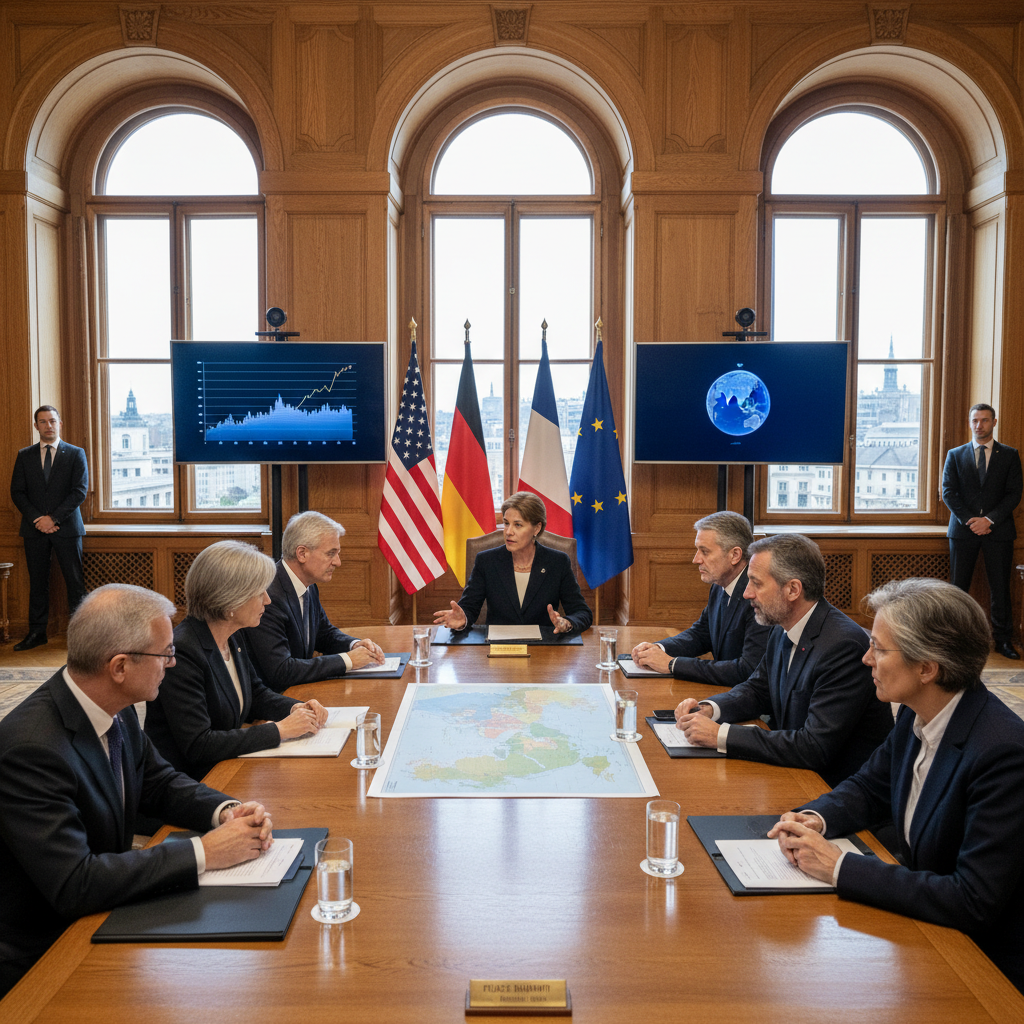
The war with Russia has now reached its fourth year, and Zelenskyy is visiting the White House for a meeting with Trump and European leaders to discuss potential support. “The first one is security guarantees. And we are very happy with President [Trump], that all the leaders are here, and security in Ukraine depends on the United States and European countries,” Zelenskyy said during a press conference with Trump. “So this is a great possibility that you offer, and it’s very important for us, a strong signal.”
Trump seemed to agree with the need for security but maintained that Europe must bear most of the responsibility. The president made clear that he thought the conflict could not be resolved without difficult discussions about territory and announced that with security guarantees, they would come. “We’re going to help them, and we’re going to make it very secure. We also need to discuss the possible exchanges of territory, taking into consideration the current line of contact. That means the war zone, the war line center.”
Zelenskyy’s visit to Washington this week is underscoring significant divisions between Western leaders over the balance between providing support to Ukraine and working to achieve a negotiated peace. Trump’s support for territorial compromises was at odds with Zelenskyy, who has repeatedly stated that Ukraine’s sovereignty and international borders must be preserved.
Sanctions, Ceasefire, and NATO Expansion
Leaders in Washington discussed security guarantees as U.S. lawmakers grew more vocal about the need for increased economic pressure on Russia and its trading partners. Senator Lindsey Graham, R-S.C., said that the Trump administration needed to take “more aggressive action” against Moscow’s financial system, including countries that continue to purchase Russian oil.
Graham is co-sponsoring a bill that would permit Trump to impose tariffs of up to 500 percent on any country that continues to do business with Russia. “My advice to President Trump and [Secretary of State Marco Rubio] is, you’ve got to convince Putin that if this war doesn’t end justly and honorably with Ukraine making concessions also, we’re going to destroy the Russian economy,” Graham said on Fox News. “The second most important person on the planet to end this war is President Xi in China.”
Trump has already used the tariff weapon. In August, he announced a 50 percent tariff on India in part over New Delhi’s decision to purchase Russian oil. Graham appeared to suggest that the threat of similar action against China could end the conflict quickly.
On the other side of the Atlantic, the European Union is also finalizing its 19th round of sanctions against Russia. The new measures, set to be adopted later this month, will seek to further restrict Russia’s energy revenues, access to European banks, and military-industrial base while also plugging some of the loopholes that have permitted countries to evade existing sanctions.
Russia is the most sanctioned country in modern history, more economically isolated than Iran, North Korea, or Venezuela, as a result of nearly four years of coordinated Western action. Sanctions, however, are not the only point of contention. European leaders also raised the issue of a ceasefire to Trump, arguing that there needed to be a period of calm before serious negotiations.
German Chancellor Friedrich Merz said that a temporary halt to the fighting was the only way to give peace talks any credibility. “I can’t imagine that the next meeting would take place without a ceasefire,” Merz said. Trump pushed back, claiming that some of the six peace agreements he says have been signed in recent months had been signed without a ceasefire. “You have a ceasefire, and they rebuild and rebuild and rebuild,” Trump said, while acknowledging that the only appeal of a truce would be the immediate cessation of civilian deaths.
Finnish President Alexander Stubb, who was inaugurated in March 2024, was also present at the White House for the talks. He has been candid about his skepticism about Russian President Vladimir Putin’s willingness to respect a ceasefire and has emphasized Finland’s long history with Russia, pointing to its 800-mile-long border with Russia. Stubb, one of Trump’s closest European counterparts, stated, “If I look at the silver lining of where we stand right now, we found a solution in 1944, and I’m sure that we’ll be able to find a solution in 2025 to end Russia’s war of aggression.”
In addition to sanctions and a ceasefire, Trump has been explicit about his conditions for peace. The former president posted on Truth Social, urging Ukraine to officially give up Crimea to Russia and stop trying to join NATO. “President Zelenskyy of Ukraine can end the war with Russia almost immediately, if he wants to, or he can continue to fight,” Trump wrote. “He should give back Crimea, which Russia gave to Ukraine 10 years ago to P, to President Obama without a shot being fired, but that doesn’t mean they have to keep it. Also, NO GOING INTO NATO BY UKRAINE.”
The contrast between Zelenskyy’s long-term security guarantees and Trump’s conditions for concessions highlighted the deep divides in Washington and Europe about how best to end the war. With new EU sanctions on the way, growing threats of tariffs, and continued fighting on the battlefield, the path to peace is caught between competing demands for compromise and solidarity.