- calendar_today August 16, 2025
.
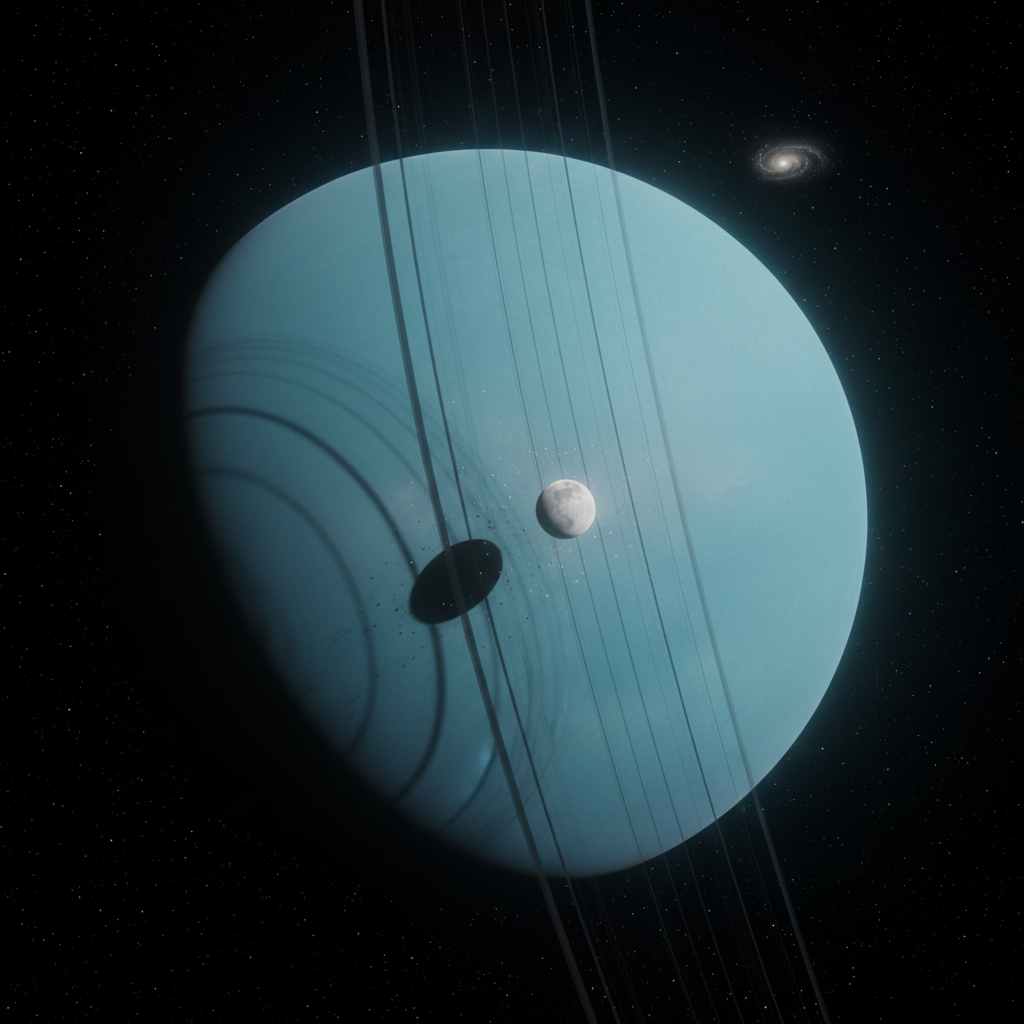
The James Webb Space Telescope (JWST) has captured an as-yet-unnamed, hidden moon orbiting Uranus. With its new tiny moon, Uranus has a known total of 29, but the total could still grow.
Webb’s detection of the small satellite on February 2 was the result of a series of 40-minute-long exposure images taken by the telescope’s Near-Infrared Camera. At just 6 miles (10 kilometers) in diameter, the newly discovered moon is one of Uranus’ tiniest natural satellites ever discovered. It was too faint and small, and Uranus’ rings shine too brightly, to have been seen by previous telescopes and missions, including NASA’s Voyager 2 spacecraft when it flew past the ice giant nearly 40 years ago.
“This is a small moon but a big discovery,” said lead scientist Maryame El Moutamid of the Southwest Research Institute’s Solar System Science and Exploration Division in Boulder, Colorado. She is also the principal investigator for a Webb program exploring Uranus’ rings and inner moons. El Moutamid noted that Webb is continuing to push the boundaries of knowledge about this planetary system much further than was possible during past missions.
Moons of Uranus: A Mystery Revealed
Beyond being a discovery in its own right, finding the new moon offers an opportunity to learn more about Uranus’ complex ring system. Scientists suspect that this new moon and portions of Uranus’s ring system may share a common origin. “The discovery raises questions about how many more small moons remain hidden around Uranus and how they interact with its rings,” El Moutamid added.
Currently, Uranus has five large major moons that were all discovered long ago: Miranda, Ariel, Umbriel, Titania, and Oberon, and then a group of satellites on smaller orbits. It is this latter group that S/2025 U1 joins as the 14th small moon in the inner system. No other planet has as many small inner moons in such proximity to one another. This baffles astronomers. The satellites are so close that their orbits could potentially cross one another. Yet, they somehow do not. Astronomers think they may serve as shepherds to Uranus’ narrow rings.
“This is a very exciting discovery,” said Scott Sheppard, an astronomer at the Carnegie Institution for Science, who was not involved in the new study, but who was part of a team that discovered another Uranus moon in 2024. Sheppard noted that this tiny object’s proximity to Uranus’ inner ring system made the discovery especially significant, adding that Webb’s exquisite sensitivity enabled the detection.
SETI Institute’s Matthew Tiscareno, who is also co-principal investigator in the Webb Uranus program, added that this new moon discovery shows the line between moons and rings of Uranus becoming even fuzzier. “Their complex inter-relationships hint at a chaotic history,” he said, noting that the new moon is even smaller and fainter than the smallest known Uranian inner moons. This means there are likely still additional hidden satellites waiting to be found.
“The discovery raises questions about how many more small moons remain hidden around Uranus and how they interact with its rings,” El Moutamid added.
Currently, Uranus has five large major moons that were all discovered long ago: Miranda, Ariel, Umbriel, Titania, and Oberon, and then a group of satellites on smaller orbits. It is this latter group that S/2025 U1 joins as the 14th small moon in the inner system. No other planet has as many small inner moons in such proximity to one another. This baffles astronomers. The satellites are so close that their orbits could potentially cross one another. Yet, they somehow do not. Astronomers think they may serve as shepherds to Uranus’ narrow rings.